
On 10 February 2026, Safer Internet Day, over 50 people from ten Swiss cantons and three countries met at the Pestalozzi Children's Village. 19 of them were in a digital room and thus followed the events from a distance. The event? The symposium organised by digitalstreetwork.ch and the OST Ostschweizer Fachhochschule on digital youth work in the prevention of extremism.
How can extremism be prevented in the digital space? And what role does outreach digital youth work play in this? On 10 February 2026, International Safer Internet Day, experts from the fields of social work, extremism prevention and other stakeholders from the interdisciplinary field addressed these questions. The aim of the symposium, a cooperation project between digitalstreetwork.ch and the OST, was to clarify key terms and concepts, provide insights into current findings and share practical experiences and challenges. 'The symposium is intended to create new networking opportunities and promote professional exchange in a field of work that is becoming increasingly important,' emphasised Nam-mi, project manager of digitalstreetwork.ch and co-host of the symposium.
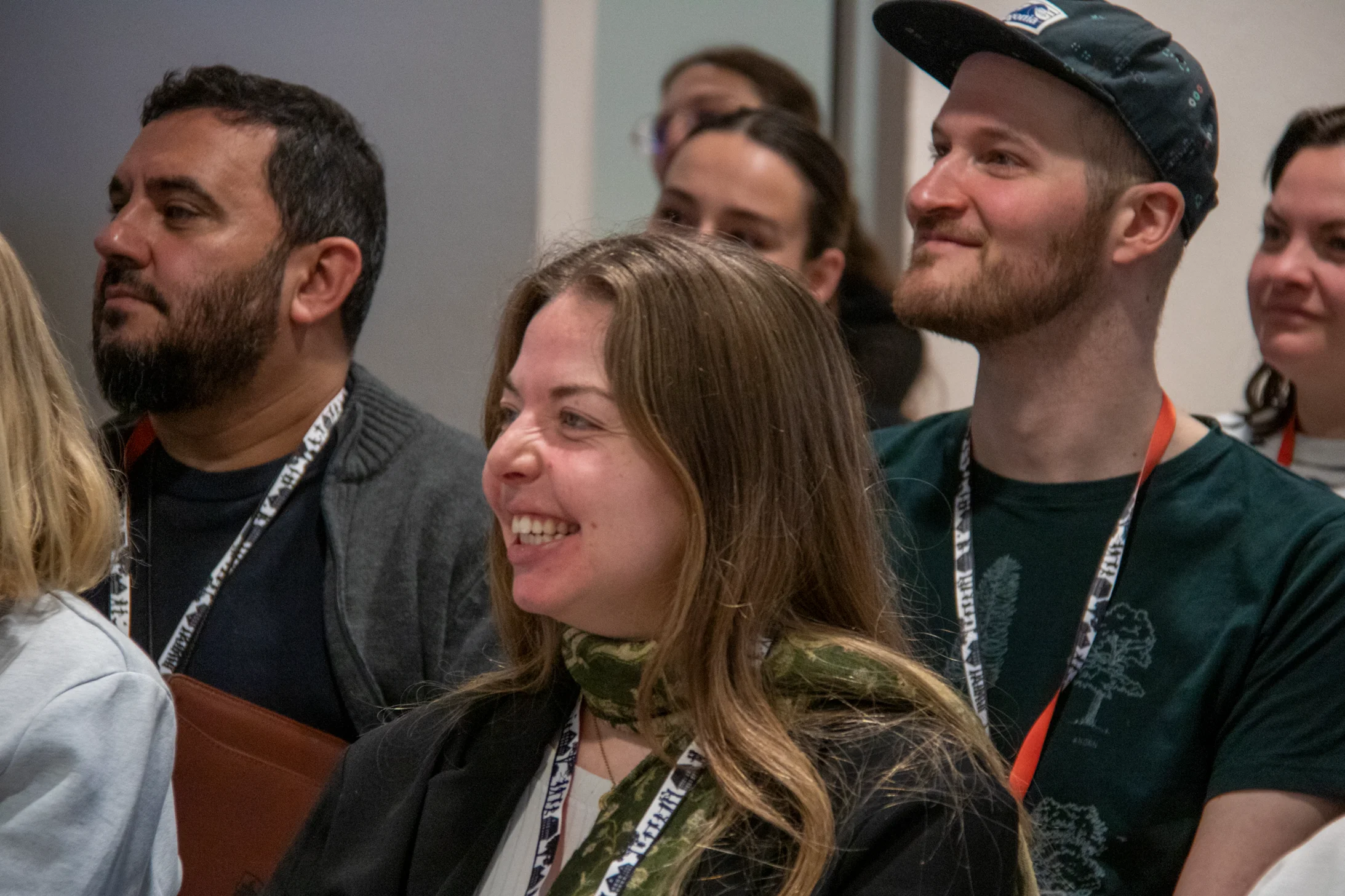
29 participants attended the symposium on site at the Pestalozzi Children's Village and 21 followed it via stream - from a total of ten cantons and three countries (Switzerland, Germany and Liechtenstein). The list of participants included representatives from municipal authorities, the police, open youth and fan work, educational institutions and counselling centres.
Overall social responsibility
Andrea Thoma, the second co-host and lecturer at the OST, started the symposium with a conceptual attempt at categorisation. It became clear that digital, analogue and social spaces cannot be thought of separately. Virtual spaces are not a counter-world to reality, but - like analogue social spaces - are created and shaped by the actions of people. For (digital) youth work, this means that professionals must not only observe these spaces, but also actively shape them and move within them.
'The symposium is intended to create new networking opportunities and promote professional dialogue in a field of work that is becoming increasingly important.'
Prof Dr Jens Ostwaldt from IU International University joined the symposium from Berlin and placed the prevention of extremism in a wider social context. Radicalisation in digital spaces develops gradually, can be influenced and thus opens up opportunities for prevention, relationship work and intervention. Prevention on the internet starts at an early stage, for example through interaction with users in comment columns, forums or live streams.
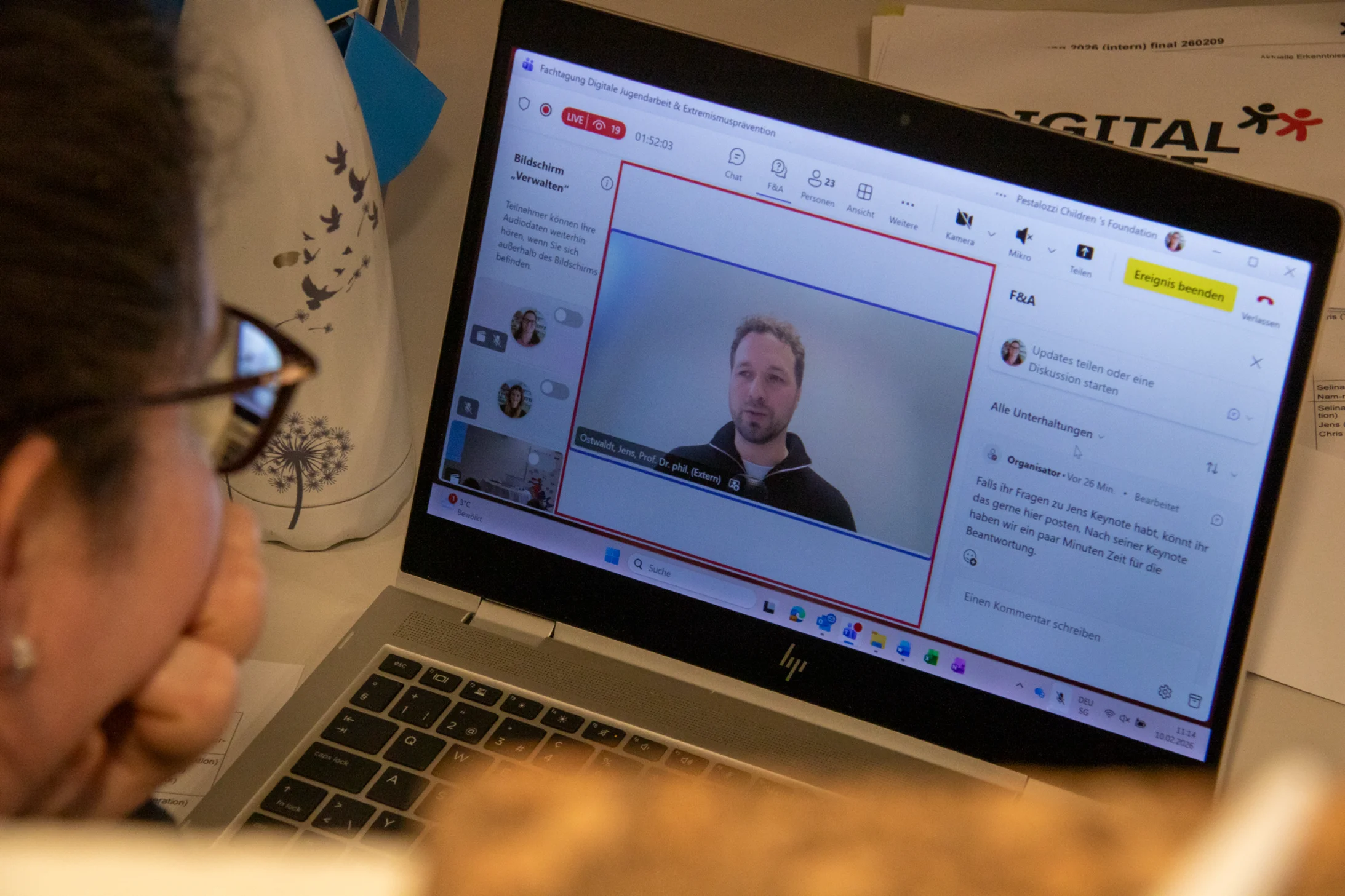
With the recurring key question 'Do we already have everything?', Ostwaldt put up for discussion whether the digital prevention of extremism actually requires fundamentally new concepts or rather utilises proven social work approaches in changed spaces. According to Ostwaldt, it is important to understand the prevention of extremism not as an isolated intervention for individuals, but as a contribution to social cohesion - and therefore as a task for society as a whole that affects analogue and digital social spaces in equal measure.
Making realities visible
digitalstreetwork.ch was presented at the symposium as a relatively new pilot project that puts the ideas outlined above into practice. Since September 2025, a team from the Pestalozzi Children's Village has been working to reach young people directly in their digitalised living environments. According to digital street worker Julian, the aim is to identify radicalisation processes at an early stage, strengthen psychosocial resources and build bridges to existing support systems. The digital street workers are present in digital spaces where radical content circulates, offer discussions, categorise problematic perspectives and support young people with questions of identity or belonging. This made it clear how the previously discussed social work approaches - relationship work, stabilisation and networking - are put into practice in the digital space and at the same time pose new challenges in terms of reach, commitment and anonymity.
In the concluding panel discussion and interactive workshops, attendees were given the opportunity to engage in dialogue with other professionals, openly discuss questions and develop common, forward-looking perspectives in this still young field of work.
The symposium is a first sign of the interdisciplinary networking of youth work, extremism prevention and digitalisation. The aim is for professionals to take on a supporting role in the digital space and use their work to ensure that young people also receive support online and can therefore move more safely and securely in the vast spaces of the internet.
With financial support from the federal government as part of the Child and Youth Promotion Act (KJFG).